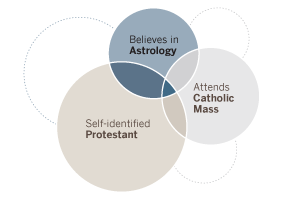
 A new poll was released recently by the Pew Research Center’s Forum on Religion & Public Life which indicates that approximately 25% of Americans “believe” in astrology.
The poll was part of a larger study on the religious beliefs of Americans which found that not only are New Age and Eastern beliefs widespread, but that seemingly conflicting beliefs are often held by the same person.
A year ago I expressed my reservations about the wording behind these types of studies which attempt to quantify the amount of “belief” in astrology, since I don’t think that most astrologers would consider themselves to be “believers” in astrology, anymore than they would consider themselves to be believers in gravity or pants or what have you.
The “Affect” of the Stars and Planets
In addition to the loaded term “believe”, this particular study seems to carry with it another problem, which lies within their definition of astrology, which is apparently as follows:
“Astrology, that the position of stars/planets can affect people’s lives.”
The word that I would like to call attention to, which was also pointed out by another astrologer on the Myspace forum recently, is the term ‘affect’. The issue here, of course, is that the majority of modern western astrologers do not hold the opinion that the stars/planets literally affect people’s lives. That is to say, most astrologers do not ‘believe’ that there is a causal mechanism underlying astrology.
Rather, the vogue for much of the past century has been to postulate an acausal connection between celestial and earthly events, loosely based on Carl Jung’s theory of synchronicity. Observe Richard Tarnas’ statements in his popular 2006 book Cosmos and Psyche:
In the perspective I am suggesting here, reflecting the dominant trend in contemporary astrological theory, the planets do not “cause” specific events any more than the hands on a clock “cause” a specific time. Rather, the planetary positions are indicative of the cosmic state or archetypal dynamics at that time. (pg. 77)
Tarnas, acknowledging that he is simply reporting what is a common notion in the astrological community, explicitly rejects the notion of a causal mechanism underlying astrology. And he is not alone.
To emphasize this point, I feel comfortable saying that, generally speaking, there are almost no intelligent professional astrologers in the west arguing for a causal mechanism underlying astrology. Now, there are of course a few exceptions to this, insomuch as I do know of a few serious astrologers who have speculated about possible causal mechanisms, however this is a very small minority of astrologers at this point in time.
Skepticism and Contemporary Definitions of Astrology
This is the case of things within the astrological community. Of course, most contemporary definitions of astrology and statements about it which originate from outside of the astrological community completely miss this point, and causal language is almost always included. Nowhere is this more prominent than within the skeptical community, where the definitions of astrology and opinions attributed to astrologers are almost universally that celestial objects directly cause events to happen here on Earth.
For example, Phil Plait of the Bad Astronomy blog, and now soon-to-be former president of the James Randi Foundation, makes the following universal statement about what astrologers claim:
Some of the claims they make are inherently contradictory (some say the moment of birth is important, others say it’s the month, etc.), but they all operate under a very broad working assumption: there is some sort of force from the heavens that influences us here on Earth. There are lots of different attributions for this force (some say gravity, some say electromagnetism, some say a force that cannot be measured), but it all boils down to the planets and stars having an effect on people.
This statement is patently false, but note that certainty and conviction with which he states that all astrologers claim this. In some ways you can hardly fault Plait, since he is simply repeating a common assumption that he and many of his friends in the skeptical community have about astrology. The problem though, is that instead of presenting some sort of reasonably accurate, albeit seemingly absurd summary like
Astrologers hold that the positions and movements celestial bodies regularly mimic or imitate terrestrial systems and events through a non-causal connection that maintains regardless of distance.
Instead they set up straw man arguments that almost always go something like this:
Astrologers maintain that the stars and planets literally cause events to happen on Earth and people to behave in certain ways. However, the gravity of distant objects is negligible. Therefore astrology is bogus. Q.E.D.
This brings me to another point though. The poverty of the modern skeptical movement is that the vast majority of those associated with it, and even many of those who lead it, are simply followers who repeat mistaken truisms about subjects that they seldom take the time to actually study, let alone understand.
Now, I will not claim that this is the case universally, as there are obviously skeptics who have done very in-depth studies into the areas that they are investigating, however it seems that the average follower within the skeptical movement is simply content to repeat the statements of others. Statements like “all astrologers believe X”, even if the statement is totally bogus. From this perspective the claim that skeptics approach all subjects with a sense of neutrality and without preconceived opinions seldom seems true.
Why We Need More Accurate Definitions of Astrology
The point of all of this is that you need to have a reasonably accurate understanding of something before you attempt to study or critique it. If even your basic working definition of the subject is flawed, then how accurate can your study really be?
8 replies on “New Poll Says 25 Percent of Americans Believe in Astrology”
Agreed, basic working definitions are fundamental and the importance of such is frequently underestimated in these kinds of surveys/studies. I also hold a devout belief in pants, though, so what do I know.
Does that make you a Pantist, or one who is a follower of Pantism?
Nope, I am more of a pant(he)ist, as I also believe in a great many other divine entities, such as socks. The Smartwool variety are particularly worthy of worship.
Smartwool??? Sacrilege!
Ah, that’s not surprising, though unfortunate that they would paint astrologers in that light. This quote is ridic :
“Astrologers maintain that the stars and planets literally cause events to happen on Earth and people to behave in certain ways. However, the gravity of distant objects is negligible. Therefore astrology is bogus. Q.E.D.”
but yes.. i dont consider astrology to be a “belief”. I am the observer and I observe synchronicity between the micro & macrocosmos ( microcosmos being the events at the human level.. day-to-day and on the scale of the world… macrocosmos being the motions and aspects of the planets ) Pity some generalizations about astrology are still being perpetuated at this age
Good article. That 25% of Americans now ‘believe’ in astrology is a good start. When more Americans start to acknowledge that astrology has validity we can claim progress. The other 75% might want to consider this: a leaf does not have to ‘believe’ in photosynthesis to turn green.
By the way, you can’t stop evolution! There was a time when 25% of Americans thought Jim Crow laws were ethical!
When people ask me if I “believe” in astrology, I as them, in return, if they “believe” in light bulbs. After all, to the person who has never seen a light bulb before, they would seem fantastical – as could the claim that they produce light.
But, as with astrology, when they are put to use properly, they “just work”.
I have always found that “skeptics” are people who start with an answer (which they almost always got from someone else) and then seek to pair it with a question. Genuine science, however, requires that you start with a question, and then work towards using logic to find an answer.
Which brings me, further, to the point that I have seen such poor “logic” skills from the vast majority of “skeptics” that I find myself almost feeling ashamed for them that they could think to consider themselves scientists.
It seems to me that what we are seeing here is not just laziness in parroting the herd and status quo, but a deep seated terror. After all, if the herd disapproves, the majority of these “scientists” will be unable to get funding, find a job, etc. Ergo, blind rejection and faulty logic to attack a subject they know very little about, if anything at all.
Truly a sad state for mainstream science. And you wonder what could have been without such a situation.
Most people’s belief or knowledge of astrology is limited to the horoscope predictions that they read in the paper.
Astrology is generally speaking, a very misunderstood subject. I believe a genuine astrology reading might even get a hard boiled skeptic to rethink a few things.