 So you want to learn about astrology? Not the generalized Sun-sign stuff that you find in newspapers and magazines, but serious astrology. The advanced type where you can actually determine specific information about a person’s life through the observation of the planets and other celestial phenomena.
Perhaps you recently found out that there is a lot more to astrology than simply knowing what your zodiac “sign” is, and you want to know how you can learn more about the subject.
What follows are 10 tips on different steps that you can take and resources you can use in order to begin learning astrology.
Once you have completed these steps you should be well on your way to becoming an astrologer. So, let’s get started with the first tip for learning astrology:
1. Get A Copy of Your Birth Chart
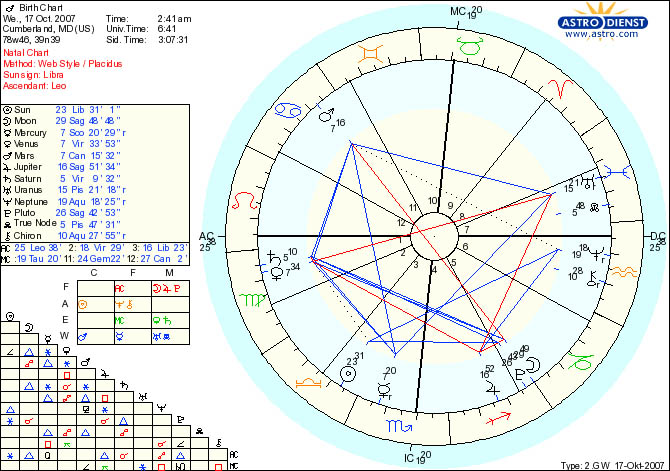
First things first: go to the Astrodienst website at www.astro.com and get a copy of your birth chart. A “birth chart” or “natal chart” is a diagram which depicts the positions of the planets at the moment that an individual was born. This chart is the fundamental basis of just about everything that astrologers do, so obtaining a copy of your own birth chart obviously needs to be your first step.
Astrodienst is a very important website for many astrologers because they offer a number of free services, including chart calculation.
In order to get a copy of your chart from Astro.com go to their “Horoscope Drawings & Calculations” section, and then click Chart Drawing, Ascendant. It will ask you if you want to create a free account or just use a guest account. Either one will work.
 After this it should take you to a page where it asks you to enter your birth information, which includes the exact date, time and place you were born. It is very important that all of the information that you enter in here is accurate. In particular, make sure that your time of birth is as close to exact as possible, since this plays a pivotal role in the interpretation of the chart. If you are unsure of your birth time then check to see if it was recorded on your birth certificate.
Once you enter all of your data in and then press continue the system should generate a copy of your birth chart. It should look something like the example chart on the right.
Look over your chart and become familiar with it. Get to know what all of the different positions in the chart are, and memorize the different symbols or “glyphs” for the planets, signs of the zodiac and “aspects.” See my article on the astrological symbols in order to start learning how to recognize them.
2. Make Use of Free Astrological Resources Online
The next step once you have your birth chart is to start learning how to interpret it, in order to figure out what it means. In order to do this you are going to need some help. The best thing to do at this early stage is to start looking around the internet for free resources that you can use in order to learn about the chart and in order to provide you with some interpretations of it.
I cannot stress enough how valuable of a resource Astro.com is in this area. In their “free horoscopes” section they have some great stuff such as the “Astro Click Portrait” and the “Personal Portrait” which provide some useful free interpretations of your natal chart. They also have some introductory articles on astrology, including stuff on the planets, signs, and aspects.
There are also a number of other free resources available in various places on the internet, although sometimes the good information can be hard to find since there is a lot of junk out there as well.
- The Mountain Astrologer’s beginner’s series provides a wide range of different articles on basic topics that are excerpted from their popular astrological magazine (which is a good resource itself).
- Skyscript.co.uk provides a lot of excellent articles and information different topics, especially the more traditional forms of astrology.
- The Astrology Dictionary is an online dictionary for terms and concepts used in astrology that I’ve been building recently.
You may also want to check out some of the following articles that I’ve written here on my blog:
- Video on the history of western astrology
- Video tutorial on how to draw the astrological glyphs
- The difference between the tropical and sidereal zodiacs
- Benefic and malefic planets
- The concept of sect
- Whole sign houses
You can also find a lot of good websites just by searching Google for specific astrological terms or keywords.
3. Get Lots of Books on Astrology and Read Voraciously
When it comes down to it, the vast majority of the really good information on astrology is contained not on websites and blogs, but in books.
Amassing a sizable astrological library tends to be a must when it comes to studying astrology. Usually it is safest to start off with some basic introductory books, and then work your way up to the more advanced stuff. Here are some useful introductory books for getting started in astrology:
 The Essential Guide to Practical Astrology by April Elliott Kent. This book just came out a few years ago, and it does an excellent job of outlining the basic terms and concepts used in modern astrology. This would be a good book to start with if you don’t known anything about astrology and you want to start learning it from the ground up. April does a great job in conveying the practical concepts and ideas in a very clear and concise manner, and the book is also really well-designed.
 Cosmos and Psyche by Richard Tarnas. If you are looking for a more scholarly treatment of astrology that introduces the subject within a broader philosophical and historical context then I would recommend this book. It does an excellent job of presenting one of the more well-formulated versions of modern astrology, which Tarnas calls “archetypal astrology.” You should be warned that the book is notoriously dense, so do not go into it expecting a light read. I can say that it is one of the more significant books published on astrology in the past century though, so it is worth the time if you intend to think deeply about the subject.
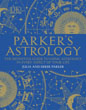 Parker’s Astrology by Derek and Julia Parker. This is a very comprehensive and well-illustrated book that has been reissued numerous times over the years due to its popularity. It is useful because they provides a number of interpretations for different birth chart placements, as well as a general overview of a number of different areas and branches of astrology. It has enough material in it to take the reader from a beginner to more of an intermediate level.
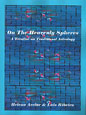 On The Heavenly Spheres by Helena Avelar and Luis Ribeiro. This book also came out more recently, but it has become my new favorite book for introducing students to the older approaches to astrology. It has a more traditional approach to the subject then the previous three books do, although it does incorporate some modern concepts as well. It is also very well-illustrated, with hundreds of diagrams and examples, and it doesn’t shy away from introducing some intermediate and advanced concepts.
Once you get some of the basics down you can start getting into more specific or advanced areas of astrology. For a more detailed list of books, see my article The 6 Best Astrology Books for Beginners.
In the end you should probably try to get as many books as you can. Unfortunately the situation is somewhat similar to the internet since there are a lot of lame pop-astrology books and other junk out there, but there are also a lot of really great books available as well. So, try to be discerning, but read as much as you can. The more widely read you are on the subject of astrology, the better your grasp of it will eventually be.
4. Learn How to Read the Ephemeris and Follow Your Transits
One very useful thing that beginning students can start doing right away is following their transits and getting a general idea of where the planets are in the sky at any given time.
The birth chart is like a snapshot of where all of the planets were when you were born, and “transits” are the current or future positions of the planets in the sky on a specific date. Obviously the positions of the planets have moved on from their original positions since you were born, and these movements have an important bearing on what will happen during the course of your life. The study of transits is one of the primary means of prediction in virtually every tradition of astrology.
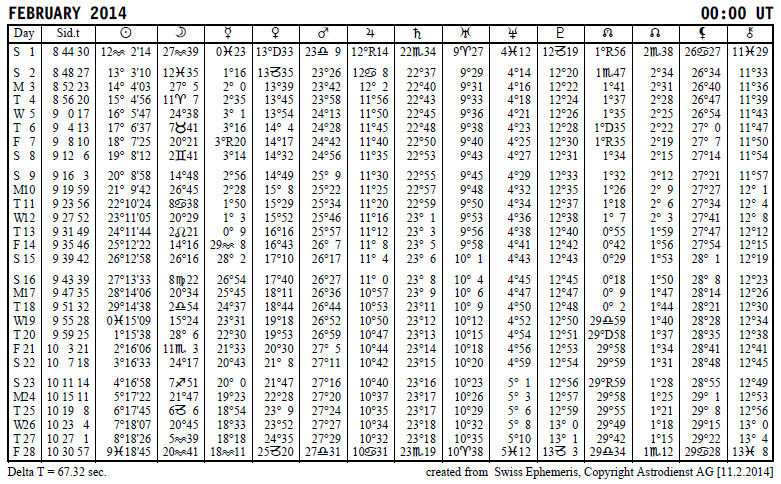 The movements of the planets are usually studied using an “ephemeris,” which is a book that lists planetary positions for every day of the year. The most popular printed ephemeris is the American Ephemeris, although Astrodienst also offers a free online ephemeris in PDF format.
Here is a link to a PDF of the ephemeris for 2014 from Astrodienst. Familiarize yourself with it. Get to know what signs the planets are in and how fast they move through each of the signs. Note where certain planets are right now relative to where they were in your birth chart. Think back to important events in your life and then check the ephemeris to see where the planets were at that time.
For more information about how read an ephemeris, and some different tips and tricks for using one, see my podcast episode on how to read an ephemeris.
 A useful resource for following transits is Astrodienst’s personal daily horoscope, which tells you which transits and planetary configurations are occurring in your chart in a given day. For a small subscription fee they even provide interpretations for each transit. These delineations are derived from Robert Hand’s famous book Planets In Transit, which just about every astrologer has a copy of in their library.
After you follow your transits for a while you will start to get a sense for what each of the planets means in a chart, and how that actually plays out in real life. Eventually you can take those experiences and observations about what happened under certain transits in the past and begin applying that knowledge to the future, by anticipating what will happen when there is a repetition of similar transits. This is essentially the basis of most astrological predictions.
5. Study The Birth Charts Of Your Friends And Family
Once you have gotten the basic mechanics of your own chart down and you have started to gather together interpretations and follow your transits on a daily basis, you should start going through the same process with the charts of friends and family members.
Get their birth data, and calculate their chart. Get interpretations of their birth chart placements, and note any ways in which those placements reflect the reality of each person’s life. Follow their transits and see what happens when certain configurations occur in their chart. For example, transiting Mars conjoining their natal Mercury, or their Saturn return around the age of 29, or something along those lines.
It is also good to begin studying biographies of famous people and comparing them with the person’s birth chart. You can use resources like AstroDatabank in order to see if the birth data for specific celebrities is available. However, I should note that it does tend to be more useful to study the charts of people you know personally, like friends and family, since the real depth and subtlety of astrology comes out when you have an intimate understanding of the person’s life.
6. Connect With Other Astrologers Through Online Forums
 Sometimes students of astrology encounter problems in the early part of their studies because it can be difficult to find other people who are interested in studying the subject in depth. As a result of this, many people end up studying the subject in virtual isolation for years. This is unnecessary though, and it usually only results from a lack of knowledge about the available networking opportunities that can be used to interact with other astrologers.
The easiest way to interact with other people who are interested in astrology is to join an astrological forum online. There are lots of forums and mailing lists around the internet. The trick is just to find a good one, or at least one that you jive well with. There are quite a few to choose from.
Here are a couple that I would recommend:
- The Skyscript Forum is usually a pretty active and interesting forum, with a primary focus on traditional forms of astrology.
- The Astrodienst Forum is a great international forum that covers many different types of astrology, and has different areas for people who speak English, German, French, Spanish, Italian, Dutch, or Portuguese.
There are also a lot of decent forums on Facebook, as well as others that are scattered around in different places. I would recommend doing some searches, and then eventually you will find one that works for you.
7. Meet Up With Other Astrologers In Your Area
Talking with people online is great, but eventually it will be time to go out and actually meet up with other astrologers in person and start to interact with the wider astrological community. For most astrologers this usually involves attending local meetings.
In any given city there is usually at least one group of astrologers that meets each month in order to talk about astrology. Most of these monthly meetings revolve around a 75-minute lecture on some astrological topic that is presented either by a guest speaker from out of town, or by a local astrologer who specializes in that topic. Usually these meetings are organized under the auspices of a local astrological organization.
The main astrological organization which tends to have chapters in just about every state in the US, as well as in some cities outside of the US, is the National Council for Geocosmic Research, or NCGR for short. They provide a framework for people to start local non-profit astrology groups. On their site they have a helpful list of all of the NCGR chapters around the world, so you can find out if there is a local group in your area.
The NCGR isn’t the only group that organizes local meetings though, as there are often other independent groups and astrological organizations that form separately from the NCGR. It is important to keep an eye out for other groups in your area, since the NCGR doesn’t have chapters in every city, and in some cities with multiple groups the independent groups can be more active than the NCGR groups.
For example, in Seattle there is no NCGR chapter, but there is a great local group that meets every month called the Washington State Astrological Association. In Denver there is an NCGR chapter that holds meetings, but there is also a separate group that meets each month called the Denver Astrology Group. Other countries have different national and local astrological organizations which organize meetings as well. For example, in the UK the Astrological Lodge of London holds monthly meetings.
 Over the past few years a lot of groups have started to use Meetup.com in order to help organize and announce their meetings, and this is a good place to check to see if there are any local astrology groups in your area. Just go to the Meetup website and do a search for astrology, and then it should tell you if there are any groups in your area that focus on that topic. If there isn’t then you might consider starting your own astrology group at some point in the future.
Local astrology meetings are great because you will often get to hear some really interesting lectures on astrology, sometimes presented by famous astrologers, and you also get to meet with other people who are interested in the same subject as you.
8. Take Some Classes on Astrology
Once you have met some other astrologers and gotten some of the basics of astrology down, you should think about taking some classes somewhere. Having some guidance from someone with experience in this area can be incredibly helpful, and it speeds up the learning process so that you will be covering more ground than if you were just teaching yourself.
There are many opportunities for taking classes depending on what your schedule is like and how much you are willing to commit to it. The easiest thing to do is to ask around in your area and see if anyone is offering any local classes on astrology. This is where attending local astrological meetings comes in handy, since the people who attend those meetings are the ones who would know what is going on in your area.
If you can’t find any local classes in your area then you might try taking a course online. This is starting to become more of a popular medium for presenting astrology classes. For example, I offer two online courses in astrology right now:
There are also a number of online schools for astrology:
- Kepler College
- International Academy of Astrology
- The Faculty of Astrological Studies
- The American College of Vedic Astrology
There are lots of other courses available, so do some research in order to find one fits your specific needs and interests.
9. Join An Astrological Organization
There are a number of astrological organizations set up all over the world in order to help promote astrology and connect astrologers. Some organizations specialize in specific things or are geared towards a specific purpose, while others are just set up in order to help make it easier for astrologers to connect with one another.
Here are some of the main astrological organizations in the English-speaking world:
- The National Council for Geocosmic Research provides a lot of networking opportunities for astrologers, and they facilitate the establishment of local astrological chapters all over the world. They also publish a journal twice a year.
- The International Society for Astrological Research is a more internationally-oriented astrological organization that organizes conferences and publishes a journal three times a year.
- The American Federation of Astrologers is the oldest astrological organization in America. They act as a publishing house for astrologers, and they have released a research journal sporadically since the early 1980s.
- The Astrological Association of Great Britain is the largest astrological association in the UK, and they put out a number of important publications and hold an annual conference.
- The Association for Astrological Networking – The name is self explanatory, although they also do a lot to help astrologers if they get into legal troubles due to anti-astrology laws and such.
- The American Council of Vedic Astrology is the main organization in North America that promotes the study and practice of Indian astrology.
- Association for Young Astrologers helps newer and younger astrologers who are just getting into the field, usually by providing scholarships to attend conferences and other such programs.
- The Organization for Professional Astrology provides publications and event programs for amateur and professional astrologers. They also organize retreats where astrologers come together to discuss their practice and learn from one another.
All of these organizations send out regular newsletters and publish some sort of journal, and many also offer some form of certification in astrology. They also occasionally put on large-scale astrological conferences, which brings us to our last tip…
10. Attend An Astrology Conference
The final step is to attend an astrological conference. These conferences are a big deal to many astrologers because they provide important networking and educational opportunities. Some are done regularly at specific intervals, like once a year, while others are only one-time events.
The conferences themselves are usually held at large hotels or convention centers. There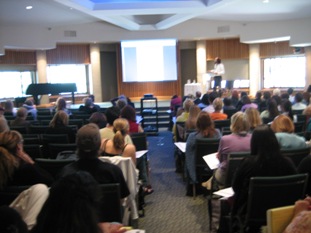 can be anywhere from a few hundred to over a thousand astrologers in attendance, depending on the conference. The conference itself usually consists of 3 to 5 days where you have a lineup of notable astrologers who are each giving lectures and workshops on various topics in different rooms. Some people cover basic topics, while others cover intermediate and advanced topics. Much of this depends on the nature of the conference though.
People who are new to astrology usually attend the conferences in order to see some lectures and learn from the presentations. More seasoned astrologers tend to attend conferences in order to meet up with their friends and catch up with one another, and maybe to see a lecture or two. Many of the conferences tend to be geared more towards newer astrologers though, so they provide an excellent learning opportunity, as well as the chance to meet some other astrologers and build friendships.
The organizations are usually the ones that organize the conferences, so you should check their websites to see if they have any planned for the near future.
Here are just a few major conferences that I know are happening in 2014:
- The Northwest Astrological Conference in Seattle, WA, May 22-26, 2014.
- The Astrological Association of Great Britain Conference in Wyboston Lakes, Sept 12-4, 2014.
- The International Society for Astrological Research Conference in Phoenix, AZ, Sept 25-8, 2014.
These are the main conferences happening this year, although there are probably a number of smaller conferences and workshops happening at different points as well. You should do some research and see if you can find a conference that has some specific lectures or focuses on a particular topic that you are interested in learning more about.
Conclusions
Well, that’s it. Once you’ve completed all of these steps you should be well on your way to becoming an astrologer. It may seem like a daunting challenge at first, but with a little bit of patience and dedication you should be interpreting charts like a pro in no time. Good luck!
2018 Video on Five Tips for Learning Astrology
I recently made a video version of this post, with five quick tips for learning astrology:
62 replies on “10 Tips For Learning Astrology”
great list. the only thing i would add is for the student to actually draw charts out by hand.
hey, thanks for your work.
sd
[…] So you want to learn about astrology? Not the generalized Sun-sign stuff that you find in newspaper… […]
Good advice:) an astrologer friend taught me to keep a journal and pay attention to transiting planets, like you said, and how things play out in your life. Another way to understand the signs is to pay attention to and meditate on the seasonal phenomenoms that occur while the sun is in each sign. Pisces the ice is melting and the earth is muddy, Gemini seeds are released and blown away, Scorpio life is turning inward as leaves are falling… It’s an ongoing fascinating study, one is never finished:)
Following the moon through your chart, and its transits of your houses and planets could be helpful in learning about your life and seeing astrological influences at work.
[…] featured article » 10 Tips For Learning Astrology Fri, 10/19/07 – 3:23 | 54 Comments […]
Fantastic article and list of information.
Thank you!
…and I love the ‘Astrology for Yourself’ book! Being a beginner myself, it’s a terrific resource.
Thanks and Happy New Year!
My advice would be to start practicing with a professional astrologer as soon as you get a chance. That way you get to practice what you read. Simply bookiss knowledge would take you nowhere.
Great list, thanks Chris. Really good to see somebody looking to help out younger astrologers that are wanting to learn the skill.
You know what they say though, practice makes perfect!
I disagree with Steven. I think having a newcomer to the study of astrology may draw out their first chart may be intimidating. I would let a person build their love of astrology before asking them to draw their own chart.
Great. At least I found someone different from Linda Goodman type shallow “astrologers”. They all have bugged my nerves!!!!
Hey Chris,
Thanks for stopping by and commenting on my blog. Love your site! Complete treasure trove of information. You’ve definitely found a new fan!
Best,
Damien
[…] few years ago Chris Brennan wrote a comprehensive list of what is actually involved in becoming an astrologer which is well worth visiting . Back in the […]